
What Mini Golf and Crazy Golf Mean
In everyday UK use, mini golf and crazy golf often name the same leisure activity: putting a ball around a short course. The labels can vary between venues, so they do not establish a universal difference in rules, difficulty or design. UK Mini Golf Guide is an independent English information guide, not a shop, venue, booking service, school or organisation, and not a former project of this domain. The common meanings of each label can help you compare listings before choosing a round.
Mini golf
Mini golf is a leisure activity in which you use a putter to send a ball towards a hole on a compact course. In the UK, the term is commonly used and can describe anything from a simple putting game to a family visit at a dedicated attraction. It is often used as a broad, approachable label rather than a precise technical category.
Venue names and listings use “mini golf” in different ways. One may call its attraction mini golf, while another uses adventure golf or a themed name for a similar outing. The wording alone does not tell you exactly what the course looks like or what rules apply; those details come from the venue. You may also see the phrase used for indoor and outdoor activities, so check the listing for the location and experience offered. For mini golf in the UK, treat the name as a useful starting point, then read the venue’s description before making plans.
Crazy golf
Crazy golf is the familiar UK name for a round of putting on a small leisure course. The word “crazy” often suggests a playful experience, and venues commonly use it when their course has a lively or unusual character. That association helps set expectations, but it is not a formal definition: the name does not guarantee a particular design, level of challenge or set of rules.
For UK players, crazy golf can describe the same broad activity that another venue calls mini golf. Some operators favour “crazy golf” in their attraction name or advertising, while others use “mini golf” for a comparable visit. There is no universal boundary that makes one label a separate sport or fixed course type. If you are searching for crazy golf courses near you, check photographs, the venue description and any stated rules rather than judging the experience by its name. In practice, the listing tells you more than the label.
How a Course and Round Work
A round of mini golf follows a simple rhythm: take a putter and ball, play each hole in turn, and record the strokes used. The equipment is designed for short putting shots rather than full golf swings. Across mini golf in the UK, course designs can range from simple greens to routes shaped by slopes and barriers. Knowing how a shot is counted and what may redirect the ball helps you approach each hole with a clear plan.
Holes, balls and putters
Mini golf equipment is made for controlled putts over short distances, with each hole played from its own starting area. The aim is to complete every hole in as few strokes as possible.
- A putter has a short shaft and a flat striking face, making it easier to guide the ball with a compact swing than with a full golf club.
- The ball is commonly a hard, lightweight plastic type, though its exact material and size can vary between venues and course formats.
- At a hole, you place the ball in the designated starting area, then aim along the playing surface towards the cup or target.
- Each intentional strike counts as a stroke; after the ball stops, you play again from its new position until it reaches the hole.
- Keep a tally for each hole, recording the number of strokes taken before moving on to the next numbered starting area.
- Once the ball is in the hole, compare your stroke count with your own total or the scores of the people playing with you.
Use a relaxed grip and a small, steady movement to control the putter face and pace on short approaches.
Obstacles and course layout
A course does not follow one standard layout: the shape of each hole and the obstacles between the starting area and target determine the ball’s route. Before putting, look at the surface and identify the line that gives you the clearest approach.
- A slope can pull a slowly rolling ball to one side or speed it up downhill, so judge both the direction of the incline and the distance to the target.
- Barriers such as rails or low walls can block a direct line, while a rebound may send the ball towards a more favourable part of the hole.
- A sharp turn means the ball must change direction around a corner; consider where it needs to finish after the first part of the route.
- Bridges, tunnels, ramps or other obstacles may channel or lift the ball, and their position can make a straight putt impossible.
- One hole might offer a broad, open approach, while another at the same venue may use a narrow passage, raised section or angled barrier.
- From where your ball rests, check the target line, nearby edges and likely rebound points, then choose a pace that suits the route.
A brief look at the slope and obstacles before each putt is a practical way to choose a more controlled line.
Common Mini Golf Formats
Mini golf courses range from simple putting layouts to more elaborate settings built around decoration and physical obstacles. The distinction is mainly about what shapes each shot: the surface and slope, or features such as ramps and themed props. In the UK, a venue may also combine both approaches, so the name alone does not tell you exactly what to expect. Looking at the layout gives you a clearer idea of the style of play before you arrive.
Putting-focused courses
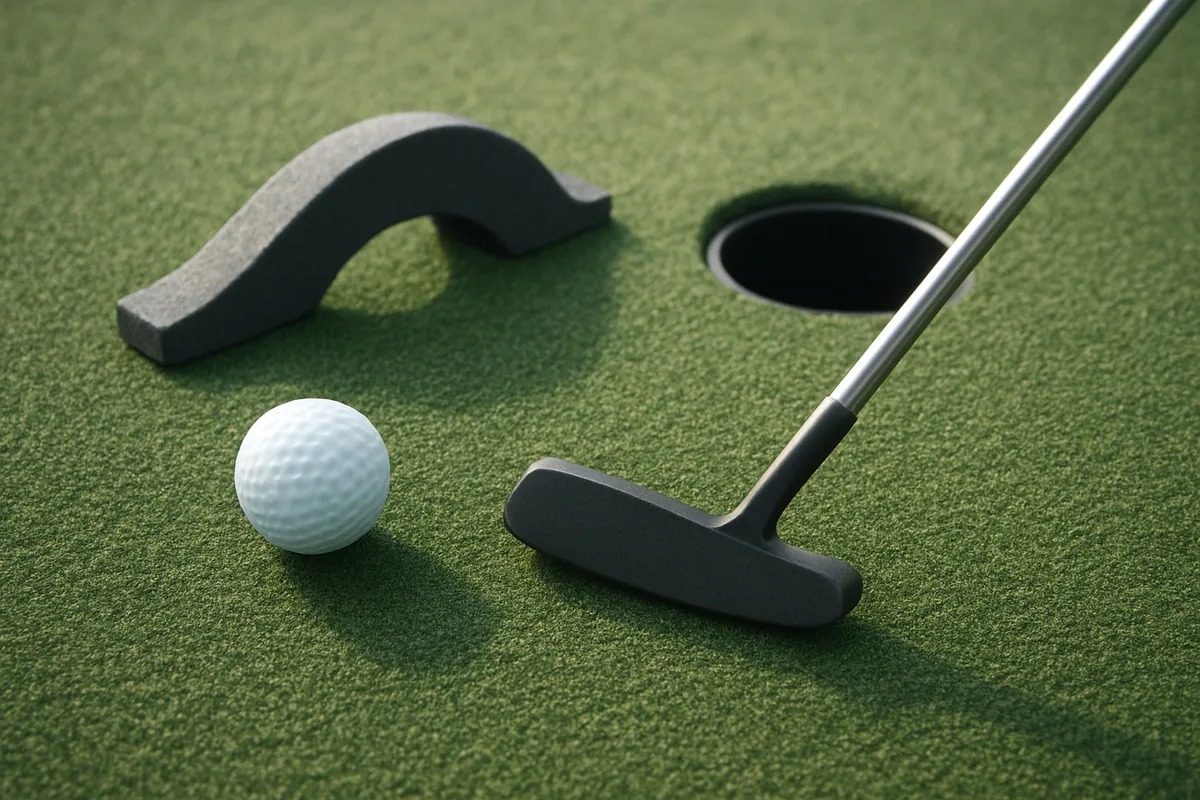
Putting-focused courses keep the emphasis on the path from your ball to the hole, with relatively open lanes and fewer decorative features to negotiate. A lane may be straight or curved, and its surface can range from short artificial turf to a firmer, smoother finish. Those differences affect how far a putt rolls: a slower surface tends to need more pace, while a slick surface rewards a lighter touch.
Small changes in slope and distance supply much of the challenge. A gentle rise can slow the ball, a downhill section can carry it past the target, and a side slope can draw it away from a direct line. Courses vary in hole length and contour, so there is no single standard layout or distance to expect.
On your first visit, expect to make simple adjustments as you see how the surface responds. You can focus on choosing a clear direction and matching your stroke to the lane, rather than following a sequence of elaborate set pieces. This format suits you if you want the putting itself to remain the main test.
Themed and obstacle courses
Themed and obstacle-heavy courses add visual settings or physical features that influence the route to the hole. Compared with a straightforward putting layout, you may encounter a ramp, a narrow passage, a raised section or a moving feature; the exact combination differs by venue. This comparison shows the kinds of differences you might notice, not a fixed design shared by every course.
| Criterion | Simpler putting layout | Themed or obstacle-heavy layout | First-time expectation |
|---|---|---|---|
| Layout | Open lanes with a straight or curved putting line | Decorative setting, such as a cave scene, or features such as a ramp and narrow passage | Look over the route before taking your shot; the setting may change from hole to hole |
| Typical challenge | Surface speed, gentle slope and the distance to the target | Finding a route around or over a feature while judging pace and direction | Expect the obstacle to affect your line, not just the appearance of the hole |
| What the layout foregrounds | Putting across a relatively clear surface | Putting combined with themed details and changes in the playing path | Each new setup may take time to assess; one hole may feel unlike the next |
If you are choosing between formats, a putting-focused course offers a more direct test of touch, while a themed layout adds variety through its setting and features. For a first visit with friends or family, choose the style that sounds enjoyable to you, then take a moment to read each hole before you putt.
Mini Golf, Crazy Golf and Other Golf-Style Games
Golf-style leisure activities can sound similar, particularly when venues use different names for comparable games. To tell them apart, consider the playing area, equipment and type of shot involved. Some activities focus on putting across a compact course, while others use golf clubs for longer shots. These distinctions can help you choose the format that suits your plans.
Miniature putting and other golf games
Mini golf and crazy golf overlap in everyday UK usage: both commonly describe a short game built around putting a ball towards a hole. The activities below show how miniature putting differs from other golf-style options.
- A miniature putting game uses a compact course and putter-led shots; its small scale makes the putting surface, rather than distance, central to play.
- Crazy golf is often another name for miniature putting, including at themed venues; the label alone does not establish a separate set of equipment.
- Full-size golf uses a range of clubs, including drivers and irons, on a much larger course where players make longer shots as well as putts.
- Pitch-and-putt uses golf clubs on short holes, so players may hit an initial shot before putting; it is not simply a miniature putting course.
- A driving range is for practising shots from a hitting area towards targets, rather than playing a sequence of miniature holes with a putter.
- “Putt-putt” is another informal term for miniature putting; in the UK, venue names and descriptions can vary between local leisure attractions.
When comparing mini golf in the UK with other golf games, check whether the activity centres on putting or includes longer club shots. That distinction is more useful than the name alone.
Mini driver golf
Mini driver golf is a related golf-style term, but it refers to play with a mini driver club, not to a miniature putting course. A mini driver is a tee-shot club with a more compact head and typically a shorter shaft than a conventional driver. Players still use full-size golf equipment and make longer shots, rather than guiding a ball around a small putting layout with a putter. The name can therefore sound like mini golf while describing a different activity and scale of play. For the equipment and playing style, look for the “Mini Driver Golf” explainer. If you want a compact putting game, choose mini golf; for longer shots with a mini driver, choose a suitable full-size golf setting.
Common Misunderstandings
The labels mini golf and crazy golf can suggest a clear distinction, but UK venues do not use them consistently. A course name alone may not tell you how its holes are designed or how a round is scored. The same applies to rules: a winding course with ramps and obstacles does not automatically follow a special rulebook. Check the venue’s own instructions before you play, especially if your group is keeping score.
Names are not fixed categories
Across the UK, “mini golf” and “crazy golf” are often used for the same kind of short, putter-based activity. Some venues favour one label for branding, while others use both to describe their attraction. There is no single formal distinction applied consistently across UK leisure venues, so the names alone do not define a course category.
One venue might call a straightforward putting layout crazy golf; another might use mini golf for a course filled with themed obstacles. Both can involve aiming a ball into a hole over a short course, even when their settings and visual styles differ. The wording on a sign or booking page is therefore a useful clue to the experience, not a guarantee of a particular design.
When comparing mini golf vs crazy golf, look at the course photographs and the venue’s description rather than assuming one label means more obstacles or a different level of difficulty. If a specific feature matters to your group, ask the venue what the course includes before booking.
Rules depend on the venue
An obstacle-heavy hole does not, by itself, establish a separate rule set. Before your first putt, check the venue’s posted instructions for details such as:
- Stroke limits: Some venues cap the number of strokes recorded on a hole; check whether reaching that limit sets a maximum score or ends play.
- Out of bounds: A ball leaving the playing area may be returned to a marked point, replayed from its previous position, or handled another way.
- Obstacle contact: Instructions may explain whether a ball that touches or moves an obstacle stays where it stops or must be repositioned.
- Ball leaving a hole: If a ball rolls back out after reaching the cup, the venue’s rules determine whether another stroke is required.
- Ties: A venue may accept a shared score or use a play-off, such as an extra hole, to decide a winner.
Follow the local instructions rather than importing rules from another course. A quick check with staff before play is the simplest way to keep your group’s score consistent.